
Action Bias
Imagine this…
You’ve just joined a team as a sustainability lead with the mandate to start making the business more sustainable.
You are brimming with ideas: swap the fleet for EVs, install automated low-flow taps, switch energy providers, use recycled paper, stop buying biros.
You can’t wait to begin, so where do you start?
The stationary cupboard.
You open the door, and it’s a graveyard of single-use plastic. Biros, plastic folders, bubble wrap, sticky tape, letter trays… Just looking at it makes you shiver.
So you grab a black bin bag and clear it out.
All of it. Gone.
Phew.
Now there’s space for the recycled, refillable, compostable alternatives you’ve already ordered.
It feels good.
You’ve taken action.
But wait…
Isn’t this worse for the environment?
There’s a bias at play here.
It’s called Action Bias.
It’s our tendency to prefer action over inaction, even if it's not the best thing to do.
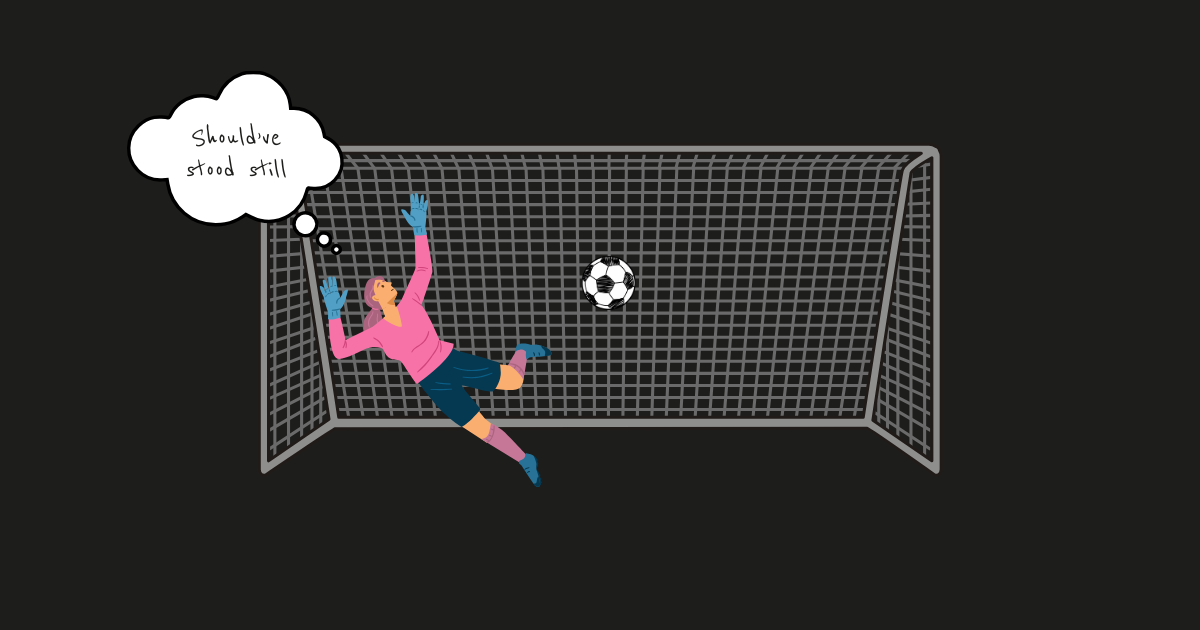
A research paper by Bar-Eli et al. (2007) found that in football penalty kicks, goalkeepers often choose their action before they can clearly observe the kick direction. They analysed 286 penalty kicks and found that statistically, they’d save more shots by staying in the goal’s centre. Basically, by doing nothing. But clearly, if you just stood still and the ball hit the top left corner of the net, you’d be ridiculed. So they jump.
Our impulse to take visible action when it comes to sustainability is no different.
Having just started a new role as a sustainability lead, you probably feel the pressure to make tangible change, fast. You want momentum. You want something you can point to and say, “Look, we’re making progress.”
And so you clear the cupboard, despite this creating bagfuls of waste.
Action relieves the discomfort.
It creates a sense of control.
It signals leadership.
But here’s the catch.
Action Bias optimises for visible progress, not meaningful progress.
Swapping pens, scrapping paper cups, buying EVs are all highly tangible.
But if you want to make meaningful change, you might be better off starting with carbon accounting, rewriting procurement policies, or rethinking business travel.
While composting food waste is important.
It doesn’t compare to establishing a policy stopping all air freight.
So here’s a challenge...
No matter your role within an organisation, you can make a difference that positively impacts people and planet.
Be it marketing, buying, admin, sales, customer service, or warehousing, you can start conversations and challenge the business to think different. All you need is to take a moment and find an opportunity to do things differently.
So, ask yourself:
What things are we doing that's wasteful?
What are we avoiding because it seems hard or impossible?
Where could a small, maybe invisible, change create an exponentially positive impact?
If you found this helpful, pass it on.
